
Some leaks are just too small, or too well hidden, for the usual tests to find. Product goes missing, the inventory numbers don’t add up, and yet the vacuum box shows nothing. That’s often when tank inspection companies bring out helium.
Helium leak detection uses helium gas as a tracer. The gas is put on one side of a weld, wall or floor, and a very sensitive detector looks for it on the other side. Since helium atoms are tiny and there’s almost none of it in normal air, even a very small leak shows up clearly. It’s often the only test that works when a leak is too small for bubbles or pressure readings to catch, or when it sits somewhere hard to reach, like under a tank floor, between the walls of a double-wall tank, or behind a nozzle reinforcing pad.
How Helium Leak Detection Works
A lot of people first run into helium testing during a fiberglass tank inspection, since double-wall fiberglass tanks at fuel sites are one of the places it gets used most. The method itself is the same on steel or fiberglass.
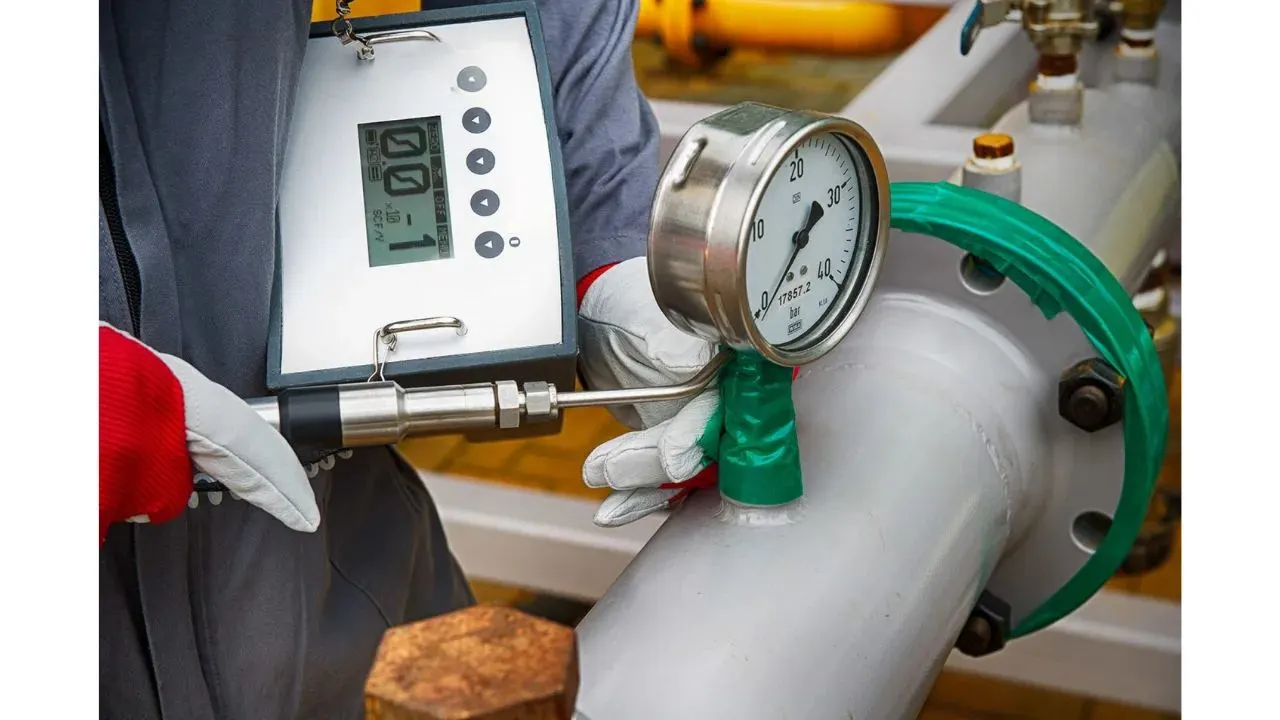
Helium gets introduced into the space being tested. That might be the inside of a tank, the gap between two walls, the sand under a floor, or the small cavity behind a pad. A technician then moves a probe, called a sniffer, along the welds and surfaces on the other side. The probe pulls in air and sends it to a mass spectrometer, which picks out helium and ignores everything else.
Helium works well for a few simple reasons. It’s one of the smallest molecules there is, so it slips through gaps other gases can’t. It doesn’t burn and doesn’t react with fuel or chemicals. And since normal air holds only about 5 parts per million of it, the detector has very little background noise to deal with. When the reading jumps, there’s helium coming through.
How It Compares to Vacuum Box and Pressure Decay
The real difference between these tests is how small a leak each one can find.
-
Vacuum box testing puts a soapy solution on a weld, sets a clear box over it and pulls a vacuum. If air comes through, bubbles form. It’s cheap and fast, but it can only see leaks big enough to make bubbles, and someone has to be able to reach each weld from one side.
-
The pressure decay test involves applying pressure to a closed volume and looking for a change in the pressure. This is a useful technique for small systems where the system is sealed well. For larger volumes like tanks or large interstitial spaces, even temperature fluctuations can produce larger pressure changes than a small leak. Small leaks get lost in that noise.
-
Helium sniffing can typically pick up leaks hundreds to thousands of times smaller than what a vacuum box can see. When the setup allows a vacuum to be pulled on the test side, the sensitivity goes even further.
So it isn’t that the other tests are bad. They just have a floor, and some leaks sit below it.
Real Places Where Helium Finds What Other Tests Miss
Tank Bottoms
Floor leaks are some of the hardest to track down. Product seeps into the soil under the tank, and there’s often no sign of it on the inside. A vacuum box only works on welds that someone can reach from inside an empty tank, and it can’t see through patch plates or into tight corners.
With helium, the gas can be sent under the floor plates and sniffed from inside, or added to the product with probes set into the soil around the tank. Either way, the helium finds the path the product has been taking. In some cases, this can be done while the tank stays in service.
Double-Wall Tanks
Double-wall tanks have a monitored space between the inner and outer walls. When that monitor shows a problem, it tells the owner something is wrong, but not where. It also doesn’t say whether the inner wall or the outer wall is the one that failed.
Filling that space with helium and sniffing both surfaces answers both questions. This is a big part of any fiberglass tank inspection on underground fuel tanks, where small cracks or pinholes in the fiberglass can be very hard to spot by eye.
Nozzle Repads
Nozzles on a tank shell usually have a reinforcing pad welded around them, with a small telltale hole drilled into the pad. During construction, that hole is used to push air in and check the pad welds with soap. That test works for bigger flaws, but a very small leak through the shell weld hidden under the pad can go unnoticed.
Helium pushed through the telltale hole and sniffed around the pad welds, and from inside the tank when possible, can find those tiny paths. It’s one of the few ways to check what’s going on behind a repad without cutting it off.
When Helium Is Really the Only Option
Helium isn’t the first test for every job. It usually becomes the right choice in situations like these:
-
Product loss is showing up in inventory records, but other tests have come back clean.
-
The leak is likely in a spot nobody can reach, like under the floor or between two walls.
-
The tank needs to stay in service while it’s being tested.
-
The system has to meet a very tight leak rate that bubble or pressure tests can’t confirm.
-
Earlier test results don’t agree, and someone needs a clear answer.
Things to Keep in Mind
Helium testing does have limits. It costs more than a vacuum box test, and it needs trained people and good equipment. Outdoors, wind can scatter the gas and make it harder to pinpoint a leak. Gas sent through soil can take time to show up. And helium left behind from earlier testing can cause false readings if the area isn’t cleared out properly.
It also only answers one question: is there a leak, and where? It doesn’t measure wall thickness or corrosion, so it works best alongside other inspection methods, not instead of them.
Picking the Right Crew
Not all tank inspection companies offer helium leak testing, nor do they have an equal level of experience in offering it. A few simple questions can help identify whether the firm is experienced. Do they have the ability to detect leaks using a particular detector and with what kind of sensitivity in the field? Have they conducted inspections on tank bottoms, double-wall tanks, or repad systems? How do they deal with wind and background helium?
Frequently Asked Questions
Is it safe to use helium near fuel tanks?
Yes. This gas is an inert one, meaning that it will not burn or react with the fuel or other storage items. It is non-toxic but, as with all gases, it may cause oxygen displacement in enclosed areas.
How small a leak can helium detection find?
In sniffer mode, helium detectors can find leaks hundreds to thousands of times smaller than a vacuum box can see. In vacuum mode, sensitivity goes even further, which is why helium is used for very tight systems.
Can helium testing be done while a tank is in service?
In many cases, yes. Helium can be added to the product or the space under the floor, and probes around the tank pick up any that escapes, so the tank doesn’t always need to be emptied.
Why is helium used on double-wall tanks?
Interstitial monitors can show that a double-wall tank has a leak, but not where it is. Filling the space between the walls with helium lets inspectors find the exact spot and which wall is damaged.
What are the disadvantages of helium leak detection?
This test is expensive compared to the vacuum box method, and it requires specialized workers. The wind can disperse the gas when tested outside, and residual helium after previous tests can affect the accuracy of the test.